

Styling Traditional Patterns for Office Wear
Table of Contents
- Why Traditional Patterns Work in Professional Settings
- How to Wear Prints to Work Without Overdoing It
- Professional Patterns and Colors That Read Polished
- How to Style an Ikat Blouse for Different Office Dress Codes
- Building Business Casual Outfits With Prints
- Pattern Mixing, Scale, and Placement Rules
- Care and Durability for Heritage Textiles
- Frequently Asked Questions
Last Updated: October 15, 2026
Why Traditional Patterns Work in Professional Settings
Styling traditional patterns brings authenticity and cultural richness to professional spaces, signaling confidence and individuality. Treat patterned pieces as intentional wardrobe staples, not costume elements.
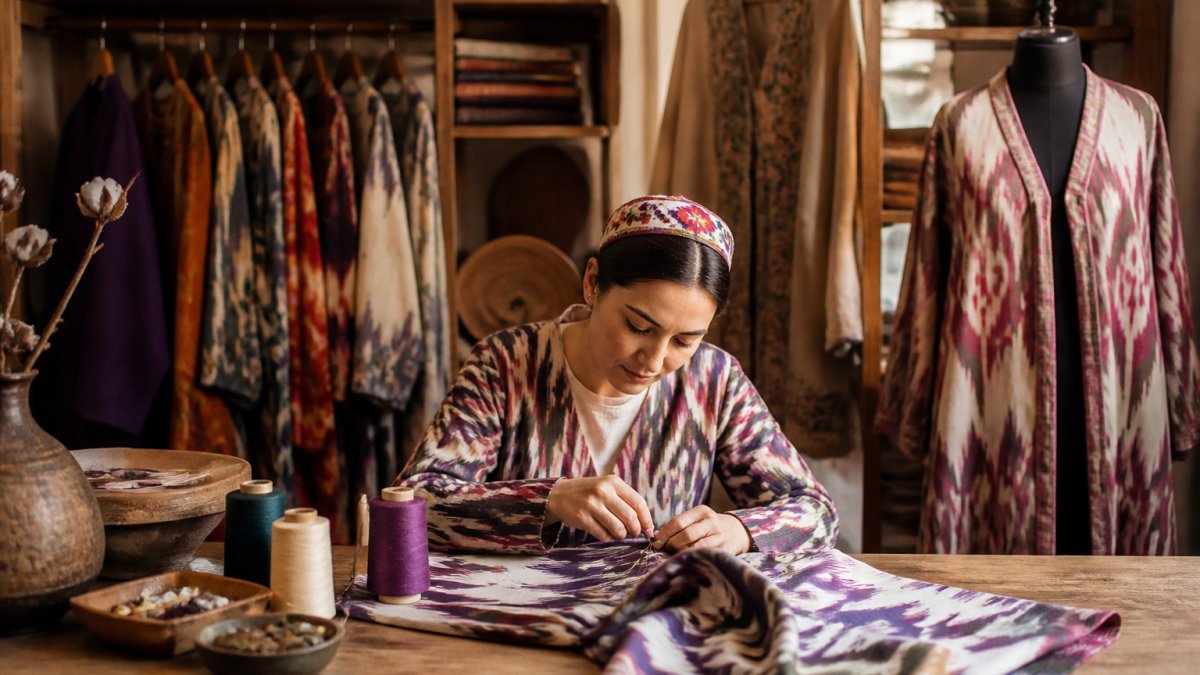
Professionals who wear heritage textiles, ikat, suzani, and other Central Asian prints often pair them with modern tailoring, neutral tones, and structured silhouettes, transforming a traditional pattern into a polished, office-appropriate statement.
The idea that patterned clothing reads as "too formal" or "too ethnic" for everyday work stems from styling choices, not the patterns. Pair an ikat print with contemporary separates and minimal accessories, and the pattern becomes a design element, not the entire outfit.
Professional settings increasingly value authenticity and cultural expression. Wearing traditional patterns signals confidence and intentionality, which translates into how others perceive your work.
How to Wear Prints to Work Without Overdoing It
The most common mistake is treating "one pattern per outfit" as the whole rule.
Start with one statement piece per outfit, then control the three variables below.
1. Scale relative to your frame. Pattern scale should be proportional to the garment and to you.
2. Contrast level. High-contrast prints (black and white, navy and cream) read bolder and more casual than low-contrast prints (cream and beige, charcoal and slate).
3. Placement. Where the pattern sits changes how formal it reads. A patterned top under a solid blazer stays contained and reads more formal than the same pattern on a full skirt or dress.
Here is how to evaluate pattern intensity by scale:
- Small-scale prints (fine geometric ikat, delicate repeating motifs): Pair with any neutral bottom; can carry slightly bolder accessories without competing.
- Medium-scale prints (traditional suzani-style patterns, medium ikat repeats): Pair with solid bottoms; keep accessories tonal and minimal.
- Large-scale prints (bold geometric or representational motifs): Pair with solid bottoms; restrict jewelry to one piece and choose a neutral bag.
Color temperature matters as much as scale.
Layering is your best control tool. A structured blazer over a patterned top frames the print and raises formality; a solid cardigan does the same at a lower tier.
One more calibration point: focal points. A patterned top plus statement earrings plus a patterned shoe is three focal points, two too many for most offices. Cap yourself at one patterned garment plus one subtle accent.
Professional Patterns and Colors That Read Polished
Not all traditional patterns work equally well professionally. The most office-appropriate are geometric rather than representational, use a limited palette, and stay visually clear from a distance.
Geometric patterns read as intentional and modern. Ikat prints with geometric precision, traditional tile patterns, and symmetrical designs work well professionally, suggesting order and structure.
Color combinations that read polished include:
- Cream or ivory with navy or charcoal (classic, versatile)
- Cream or beige with rust or terracotta (warm, sophisticated)
- White or off-white with deep jewel tones like emerald or sapphire (elegant, bold)
- Neutral base with metallic accents like gold or silver (refined, modern)
Avoid very high contrast or chaotic color combinations; a pattern that jumps visually distracts from your work and your message.
Traditional Central Asian patterns often use natural dyes and subtle color variations, which can make them ideal for professional wear: curated and intentional rather than trendy or costume-like.
When selecting a patterned piece for office wear, hold it at arm's length. If it reads as a cohesive design, it works professionally; if it feels busy, save it for casual settings.
How to Style an Ikat Blouse for Different Office Dress Codes
Ikat blouses work across multiple dress codes when styled thoughtfully. The key is adjusting your supporting pieces, bottoms, outerwear, and accessories to match the required formality.

Business Formal Settings
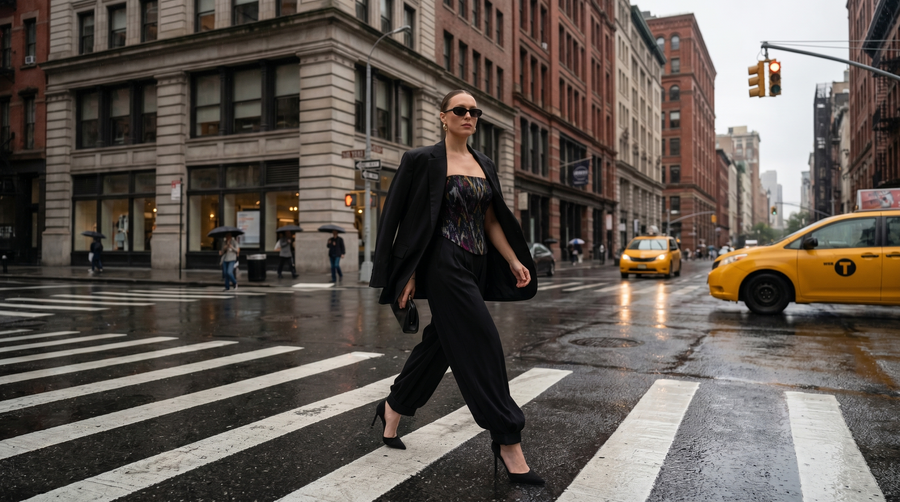
Business formal requires polish, structure, and restraint. Your ikat blouse becomes the focal point, so everything else must be impeccably tailored and neutral.
The formula:
- Ikat blouse with a structured silhouette (fitted, not flowing)
- Tailored trousers in navy, charcoal, black, or a neutral tone
- A structured blazer in a coordinating solid color
- Minimal jewelry: small studs, a delicate watch, or a thin bracelet
- Closed-toe shoes in leather (pumps, loafers, or flats)
- A neutral bag in leather or structured fabric
The Marvorid Top works exceptionally well for business formal. Its structured silhouette, premium crepe-back satin, and architectural lines create immediate polish. Pair it with tailored trousers and a neutral blazer.

Avoid flowing fabrics, loose silhouettes, or oversized proportions in business formal contexts. Structure is essential. The ikat pattern should be the only visual interest in your outfit.
Business Casual Environments
Business casual allows more flexibility: your ikat piece can be more expressive, with more layering and accessorizing options.
The formula:
- Ikat blouse or top with a fitted or semi-fitted silhouette
- Neutral bottoms: tailored trousers, a midi skirt, or quality denim
- Optional: a lightweight cardigan, unstructured blazer, or linen jacket
- Jewelry: small earrings, a bracelet, a simple necklace, or a watch
- Shoes: closed-toe or open-toe (loafers, flats, low heels, or clean sneakers)
- A structured or soft bag depending on your style
In business casual settings, experiment with layering. Pair an ikat blouse with a lightweight cardigan in a coordinating neutral to add depth and adjust formality throughout the day.
The Noor Ikat Skirt works beautifully in business casual. Its high-waisted silhouette and sheer organza overlay create visual interest while remaining professional; pair it with a simple fitted top in white or cream and a lightweight blazer.
Building Business Casual Outfits With Prints
Business casual is where heritage textiles truly shine. You have room to express your style while maintaining professionalism.
Choose your patterned piece, whether a blouse, skirt, or corset, then build around it using balance: one statement piece, everything else neutral or complementary.
Three complete outfit examples:
-
Structured ikat blouse + tailored trousers + unstructured blazer + minimal jewelry
- Blouse: Marvorid Top in ikat print
- Bottoms: Cream or beige tailored trousers
- Layer: Linen or cotton unstructured blazer in neutral
- Accessories: Small earrings, watch, neutral leather bag
- Shoes: Loafers or low heels
-
Patterned skirt + fitted solid top + lightweight cardigan + structured accessories
- Skirt: Noor Ikat Skirt
- Top: White or cream fitted blouse
- Layer: Lightweight cardigan in coordinating neutral
- Accessories: Small necklace, watch, structured handbag
- Shoes: Flats or low heels
-
Patterned corset + neutral separates + statement belt
- Corset: Noor Ikat Corset over a neutral slip or dress
- Bottoms: Tailored trousers or a midi skirt in neutral
- Accessories: Marvorid Reversible Ikat Corset Belt, minimal jewelry
- Shoes: Structured flats or low heels
The Marvorid Reversible Ikat Corset Belt is particularly useful for business casual. Wear it with dresses, tailored separates, or over a neutral top; the reversible design switches between the patterned side and the solid black side depending on your formality needs.

Pattern Mixing, Scale, and Placement Rules
Pattern mixing intimidates many people because most advice stops at "vary the scale." That is necessary but not sufficient.
Rule 1: Vary scale by at least one full step. Never pair two prints of identical scale.
Rule 2: Share at least one color. Both patterns should contain a common color.
Rule 3: Separate patterns with a solid. Do not place two patterns directly adjacent.
Rule 4: Match visual weight, not just scale. A dense small print and a sparse large print can carry the same visual weight and fight each other.
Rule 5: Know when not to mix. For business formal, do not mix two traditional patterns at all. Keep one patterned garment and let everything else be solid.
Worked examples by dress code:
- Business formal: One patterned piece only. A structured ikat blouse with solid navy trousers and a solid charcoal blazer. No second pattern anywhere, including the bag and shoes.
- Business casual: Two patterns maximum, separated by a solid. A medium-scale ikat blouse with a fine pinstripe trouser, broken by a solid leather belt. Colors share navy.
- Creative workplace: Two to three patterns, all sharing one color, all at different scales. A large ikat skirt with a small geometric top and a solid cardigan as the buffer.
Placement rules. Keep both patterns in the same half of the body (both on top or both on the bottom) so the eye reads them as a set.
When a mixed look still feels wrong, the fix is almost always subtraction, not addition. Remove the second pattern, add a solid neutral as a buffer, and rebuild one piece at a time. A white or cream layer under a patterned blazer, or a neutral skirt under a patterned top, gives the eye a place to rest and makes the look read as intentional.
Care and Durability for Heritage Textiles
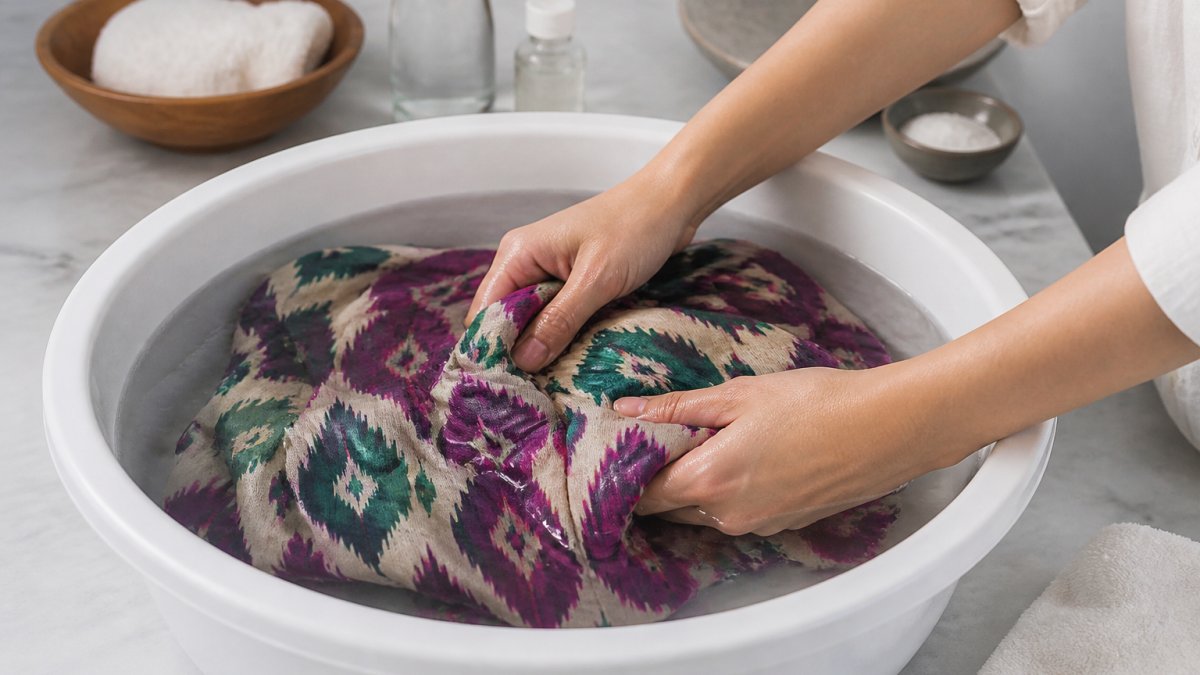
Heritage textiles require thoughtful care to maintain their beauty and longevity.
Dry cleaning is non-negotiable for structured pieces. The Marvorid Top, Noor Ikat Corset, and Noor Ikat Skirt all require professional dry cleaning.
Storage matters. Store patterned pieces flat or hanging, never crumpled in a drawer. Use acid-free tissue paper if storing flat.
Handling with care prevents damage. With delicate details like the French lace overlay on the Marvorid Reversible Ikat Corset Belt, avoid rough surfaces and be mindful of snagging; the structured construction requires careful handling to maintain its shape.

Frequency of wear extends garment life. Rotate patterned pieces rather than wearing them repeatedly, giving fabrics time to rest and reducing wear on seams and closures.
| Care Step | Frequency | Why It Matters |
|---|---|---|
| Professional dry cleaning | After 3-5 wears | Preserves fabric, color, and shape |
| Air drying between wears | Always | Allows fabric to breathe and recover |
| Flat storage with tissue | When not wearing | Prevents wrinkles and damage |
| Gentle handling | Always | Protects delicate details and seams |
| Sunlight avoidance | Always | Prevents fading of natural dyes |
Treat a piece respectfully and it becomes a lasting part of your wardrobe rather than a one-season wonder.
Styling traditional patterns for office wear isn't about compromise, it's about intention. When you choose heritage pieces that match your professional environment, you signal authenticity and cultural pride.
Frequently Asked Questions
How can you wear traditional patterns to the office and still look professional?
Start by anchoring your outfit with neutral, tailored pieces. Pair a traditional patterned top like an ikat blouse with solid-colored trousers, a skirt, or a blazer in black, navy, beige, or white. The key is letting the pattern be the statement while keeping the silhouette structured and fitted. Avoid oversized cuts, loud color combinations, or mixing multiple competing prints. Quality fabrics and polished accessories elevate heritage textiles instantly.
What traditional patterns work best for office wear?
Ikat and geometric patterns in monochrome or muted color palettes translate beautifully to professional settings. Small-scale repeating motifs work better than large, bold designs. Traditional prints that feature structured, symmetrical designs read more formal than loose, organic patterns. Signature ikat-inspired prints on premium fabrics like crepe-back satin maintain sophistication and versatility across office environments.
How do you style a bold patterned blouse for work?
Balance boldness with restraint elsewhere. Choose a patterned blouse with a structured silhouette, think fitted sleeves, defined waist, and clean necklines, and pair it with solid tailored trousers or a midi skirt in a complementary neutral shade. Add a structured blazer in a coordinating color for formal settings. Keep accessories minimal and refined: a simple watch, small earrings, and professional shoes. The Marvorid Top, with its sculpted waist and modern square neckline, pairs effortlessly with tailored separates for a polished look that works from morning meetings to evening events.
Can you wear ethnic prints in a business-casual workplace?
Yes, absolutely. Business-casual settings offer more flexibility for pattern and color. Pair a traditional patterned top with well-fitted jeans in dark wash, tailored chinos, or a casual midi skirt. Layer with a lightweight cardigan or unstructured linen jacket for added polish. Ensure the print itself reads as intentional design rather than costume, quality construction, premium fabrics, and modern silhouettes are essential. Traditional patterns on contemporary garments naturally bridge cultural expression and professional appropriateness.