
Affordable Luxury Artisanal Fashion Brands 2026
Table of Contents
- What Makes a Fashion Brand Truly Artisanal in 2026
- Quick Comparison: Artisanal Pieces Worth Investing In
- Are Artisanal Ikat Garments Worth It? A Cost-Per-Wear Breakdown
- How to Build a Sustainable Luxury Wardrobe with Artisanal Pieces
- How to Identify High-Quality Construction in Artisanal Fashion Brands
- Sustainable vs. Fast Fashion: Why Transparency and Fair Labor Practices Matter
- Frequently Asked Questions
Last Updated: September 13, 2026
What Makes a Fashion Brand Truly Artisanal in 2026
Affordable luxury artisanal fashion brands 2026 are defined by three things: hand-guided construction, traceable materials, and pricing that reflects craft rather than marketing spend. At Sadri Couture, every piece is built around that equation, from hand-applied beadwork to ikat textiles.
"Artisanal" has become a marketing word, applied to factory garments with a heritage-inspired print. Real artisanal fashion brands show you the construction: bound seams, structured paneling, hand-finished embellishment, and textiles whose irregularities prove they were made by people, not printers.
Defining Affordable Luxury: Price, Craft, and Longevity
Affordable luxury is clothing priced between mass-market and true designer tiers where the premium buys measurable construction quality rather than a logo. Longevity is the test: a garment that survives years of wear costs less per outing than a cheap piece replaced twice a season.
Three signals separate genuine affordable luxury from premium-priced fast fashion:
- Fabric weight and behavior. Crepe-back satin drapes and holds shape; thin polyester imitates the look for one season.
- Structured construction. Paneled bodices, lined skirts, and reinforced closures cost more to make and last longer.
- Repairability. French lace overlays and lace-up closures can be adjusted and maintained.
Craft is the variable most shoppers overlook. A garment can use beautiful fabric and still fail if the seams pucker or the lining twists.
Quick Comparison: Artisanal Pieces Worth Investing In
The table below maps Sadri Couture's core pieces against the criteria that decide whether an artisanal purchase holds its value. Prices are the current listed retail prices.
| Piece | Price | Construction Highlight | Best For |
|---|---|---|---|
| Marvorid Reversible Ikat Corset Belt | $98.00 | Reversible duchess satin with French lace | First artisanal purchase |
| Pari Skirt | $129.00 | Bias-cut crepe-back satin, fully lined | Everyday to evening |
| Noor Ikat Corset | $149.00 | Paneled bodice | Occasion dressing |
| The Marvorid Top | $149.00 | Contoured panel construction, square neckline | Work and dinner |
| Vintage Atlas Lace Corset | $245.00 | Vintage ikat atlas, removable peplum | Statement layering |
| The Infinite Dress | $249.00 | Capsule wardrobe foundation | |
| The Lumina Jacket | $349.00 | Hand-applied beadwork on sheer mesh | Evening and events |
| Celeste Embellished Corset | $415.00 | Hand-finished bead and sequin appliqué | Weddings and celebrations |
The pattern is deliberate: entry pieces sit under $150, embellished hand-finished work above $300, so you can test fit and construction before committing to the highest-craft pieces.

Are Artisanal Ikat Garments Worth It? A Cost-Per-Wear Breakdown
Artisanal ikat garments are worth it when cost-per-wear, purchase price divided by the number of times you actually wear the piece, falls below what you would spend replacing a cheaper alternative.
Run the math on a $149 Noor Ikat Corset: worn twice a month for two years, that is 48 wears, or roughly $3 per outing. A fast-fashion corset worn five times before the boning warps costs more per wear.
The calculation only works if the piece gets worn, and most shoppers buy artisanal clothing for one event and shelve it. The fix is built-in versatility: the Marvorid Reversible Ikat Corset Belt reverses from ikat and lace to solid black, giving two looks from one $98 purchase.
Material Science: Ikat, Suzani, and Heritage Textile Innovation
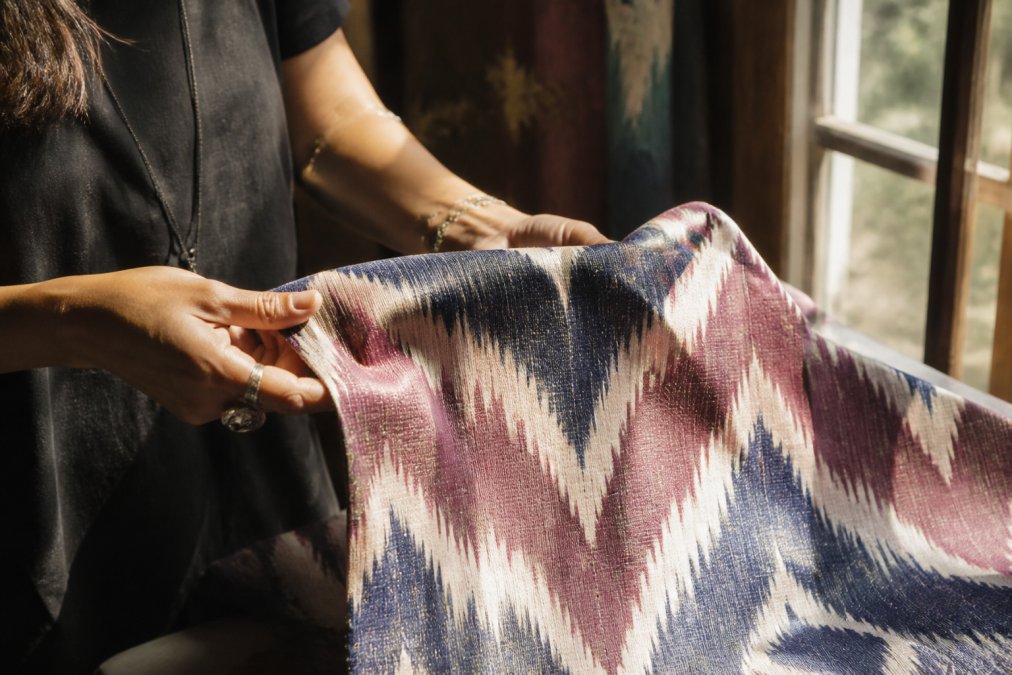
Ikat is a resist-dyeing technique in which threads are bound and dyed before weaving, producing patterns with characteristically blurred edges. That soft edge is the signature of hand-guided production, and the reason no two ikat panels match exactly.
Suzani, by contrast, is an embroidered tradition built from large circular and floral motifs stitched onto a base cloth. Both reward slower production and punish shortcuts, which is why they remain markers of genuine artisanal work.
The practical implications for buyers:
- Pattern irregularity signals authenticity. A perfectly sharp, repeating print is likely digital.
- Handled embellishment varies. Pieces with hand-applied beadwork may show slight variation, making each item unique.
- Fabric composition determines care. French lace and duchess satin require professional dry cleaning; crepe-back satin pieces tolerate careful hand washing.
How to Build a Sustainable Luxury Wardrobe with Artisanal Pieces
Building a sustainable luxury wardrobe means buying fewer pieces, choosing construction that survives repeat wear, and selecting designs that do not expire when a trend does, a small core of garments that each pair with at least three other items you own.
Start with the base layers, then add statement pieces. Most wardrobes fail because people buy the statement first and never build anything for it to sit on.
Capsule Wardrobe Essentials: Corsets, Skirts, and Investment Layers
A functional capsule built on artisanal pieces covers four roles: a foundation layer, a waist-defining piece, a skirt or trouser, and one layer for evening.
- Foundation: The Infinite Dress at $249 functions as a full-length base that works alone or under a corset or jacket.
- Waist definition: The Marvorid Waist Corset in Blue at $98 layers over dresses and shirting, or reverses to a clean solid finish.
- Skirt: The Pari Skirt at $129 is bias-cut, so it skims rather than clings, and pairs with a corset, a knit, or a tailored blouse.
- Evening layer: The Lumina Jacket at $349 adds hand-applied beadwork over a minimal dress.
Four pieces cover work, dinner, and formal occasions. The styling logic makes the wardrobe sustainable, not the fabric alone.

How to Identify High-Quality Construction in Artisanal Fashion Brands
High-quality construction shows up where photographs rarely capture it: the inside of the garment, the closure, and the hem. Turn a piece inside out before judging the outside.
Use this checklist when evaluating any artisanal purchase:
- Lining: Is the garment fully lined through the body, or does the fabric catch on what you wear underneath?
- Seam finish: Are raw edges bound or overlocked cleanly, with no loose threads at stress points?
- Closure quality: Do zippers run smoothly, and do lace-up eyelets sit firmly in reinforced fabric?
- Hem treatment: Is the hem stitched evenly, and does a sheer overlay extend cleanly beyond the lining?
- Panel alignment: Do structured panels sit symmetrical across the bust and waist?
- Fabric recovery: Does the material spring back when you gently stretch it, or stay creased?
Two or three failed checks do not make a piece worthless, but they should be reflected in the price.
Sustainable vs. Fast Fashion: Why Transparency and Fair Labor Practices Matter
Sustainable fashion differs from fast fashion in one measurable way: you can trace where the garment came from. Fast fashion optimizes for speed to shelf; sustainable production optimizes for how long the piece stays wearable. Here are the certifications and metrics that separate a real claim from a marketing line.
The Certifications That Actually Mean Something
Vague terms like "eco-friendly" carry little weight; third-party certifications require audits, documentation, and ongoing compliance. The ones most relevant to artisanal fashion:
- GOTS (Global Organic Textile Standard). Covers the entire supply chain for organic textiles, from fiber harvest to finished garment. It requires a minimum of 70% organic fibers for the "made with organic" label and 95% for the "organic" label, and sets wastewater treatment and social criteria (Global Standards). If a brand claims organic cotton but cannot name a GOTS-certified mill, the claim is unverified.
- Fair Trade Certified. Focuses on labor conditions and community development. Products carrying the seal come from facilities meeting Fair Trade's social, environmental, and economic standards, with a premium paid back to workers. It is a people standard, not a fabric standard.
- B Corp Certification. A whole-company certification, not a product one. It measures social and environmental performance across governance, workers, community, environment, and customers. Scores are public, so you can compare brands on one scale; above 80 qualifies, and higher indicates stronger performance.
- OEKO-TEX Standard 100. Tests finished textiles for harmful substances. It does not address labor or organic content, but it is a useful baseline for skin safety, especially for pieces worn close to the body.
- Cradle to Cradle Certified. Evaluates products on material health, material reuse, renewable energy, water stewardship, and social fairness. It is more common in home goods than apparel, but some forward-thinking brands use it.
A brand does not need every certification, but one that claims sustainability and holds none is asking you to take its word. Ask which certifications apply and where they appear.
Supply Chain Transparency Metrics You Can Request
Certifications are third-party; transparency is first-party. Both matter. The information a genuinely transparent brand can provide:
- Tier 1, Final assembly. The name and location of the factory that cut and sewed the garment. This is the easiest tier to disclose and the one most brands stop at.
- Tier 2, Fabric and trim suppliers. The mills that wove the fabric and produced the zippers, buttons, and lace. This is where most supply chains go dark.
- Tier 3, Raw material producers. The farms, spinners, and tanneries. Few brands can trace this far, but the ones that can usually publish a map or list.
- Tier 4, Raw material origin. The specific region or farm. For artisanal textiles like ikat or suzani, this is often the most meaningful disclosure because the technique is tied to a place and a community of weavers.
Genuinely transparent brands typically publish a supplier list with names and addresses, updated annually. If a brand will not name its Tier 2 suppliers, assume it cannot trace them.
Made-to-Order vs. Mass Production: The Deadstock Math
Made-to-order production is one of the clearest signals of a considered supply chain: it reduces deadstock, unsold inventory that ends up discounted, incinerated, or landfilled. The tradeoff is a longer wait, typically several weeks, and sometimes a higher per-unit cost without volume discounts.
Mass production is not inherently unsustainable: a brand producing in large volumes and selling through can still be responsible with certified materials and fair labor. But the fast-fashion model depends on overproduction and rapid markdowns, which is where the two diverge.
The Regulatory Backdrop
The Federal Trade Commission's guidance on green marketing claims sets the standard for how sustainability claims can be worded in the United States. The FTC's Green Guides caution against broad, unqualified claims like "eco-friendly" or "sustainable" unless the brand can substantiate them with specific evidence. That is why vague terms carry little weight without specifics, and why a brand that says "GOTS-certified organic cotton, traced to a cooperative in Gujarat" is on firmer ground than one that says "made responsibly."
Buyers who want a stronger benchmark can look to Ellen MacArthur Foundation's work on circular fashion, which documents how extending a garment's wear life reduces its environmental footprint more than any single material swap. The foundation's research consistently finds that the largest environmental gains come from wearing what you already own for longer, not from swapping one fiber for another.
Fair Labor: What It Looks Like in Practice
Fair labor matters for the same reason: a garment produced under pressure and unpaid overtime shows it in rushed seams and inconsistent sizing, however good the fabric. Concrete indicators include:
- Published wage data. Some brands disclose the percentage of workers earning a living wage. A living wage is calculated by region and is higher than the legal minimum.
- Worker committees or unions. The presence of an independent worker voice is a stronger signal than a brand's own audit.
- Long-term supplier relationships.
- Audit transparency. Third-party audits (like those from Fair Wear Foundation or Social Accountability International) are more credible than self-reported audits.
The Bottom Line for Buyers
Sustainability in artisanal fashion is not a vibe but a set of verifiable facts: a certification number, a supplier name, a wage disclosure, a production model. Ask for those facts and you separate brands doing the work from brands that have learned the vocabulary.
Frequently Asked Questions
What is considered an affordable luxury clothing brand in 2026?
Affordable luxury in 2026 means pieces priced between $98 and $415 that use premium materials and ethical production, rather than mass-produced fast fashion. Brands like Sadri Couture offer artisanal corsets, skirts, and dresses at these price points. The key is cost-per-wear: a $149 ikat corset worn 30 times costs $5 per wear, outperforming a $30 fast-fashion top worn twice.
Are artisanal ikat garments worth the investment?
Yes, when you factor in longevity and versatility. Ikat garments from artisanal fashion brands use heritage techniques and high-quality construction that resist trend cycles. A reversible corset belt at $98 offers two distinct looks, doubling its value. Unlike fast fashion, these pieces hold resale value and can be styled across seasons, making the price-to-value ratio favorable over time.
How can I identify authentic artisanal fashion?
Look for specific construction details: French lace overlays, hand-applied beadwork, structured corset paneling, and adjustable closures like lace-up backs. Authentic artisanal brands disclose fabric composition, care instructions, and production methods. Check for made-to-order models, which indicate small-batch craftsmanship rather than mass production. Transparency about supply chain and fair labor practices separates genuine artisanal brands from marketing claims.
How do I build a sustainable luxury wardrobe without overspending?
Start with versatile investment pieces that work across multiple outfits. A $249 Infinite Dress can be worn alone or layered with a $98 corset belt for entirely different looks. Focus on neutral tones and timeless silhouettes that transcend seasons. Add one statement piece per season, like the $349 Lumina Jacket, and mix with existing wardrobe staples. This capsule approach reduces waste and maximizes cost-per-wear.
What defines the slow fashion movement in 2026?
Slow fashion in 2026 prioritizes ethical manufacturing, sustainable materials, and timeless design over seasonal trends. Brands produce in small batches or made-to-order, reducing overproduction. Key markers include fair labor practices, supply chain transparency, and use of organic textiles or heritage techniques like ikat weaving. The focus shifts from quantity to quality, with pieces designed to last years, not weeks.